Calculate Bhp Per Tonne . One way to determine the efficiency of a boiler is to calculate the pounds of steam the boiler uses per hour. P (kw) = 80 bhp x 0.745699872. Bhp Group Plc 2017 Foreign Issuer Report 6K from sec.report 100 boiler horsepower = 278.93 tons of refrigeration. Bhp per ton and top speed calculator bhp per ton and top speed calculator. The sim software won't be spot on with the et/mph but it is a great help with such things as gear and.
Volume Washer Method Calculator. Enter in the line the functions will be rotated about. Volume using the washer method day 2.
calculus Volume of revolving a function around xaxis (washer method from math.stackexchange.com
\begin{equation} y=x^{2} \text { and } y=\sqrt{x} \end{equation} step 1: I can determine when solids generated by revolution will have hollow spaces. This technique is established so that we can also calculate for the volume of the solid returned by rotating the region bounded by two curves over the.
A Washer Method Calculator Is An Online Tool That Can Calculate The Volume Of A Disk Or A Washer Using The Washer Method.
(r² = 0.81) step 4: The first function equation, the second function equation, the starting interval, and the ending interval. Informally, the method of washers is a means of calculating the volume of a solid of revolution when integrating along the axis of revolution, using washers to obtain a hollow solid of revolution.
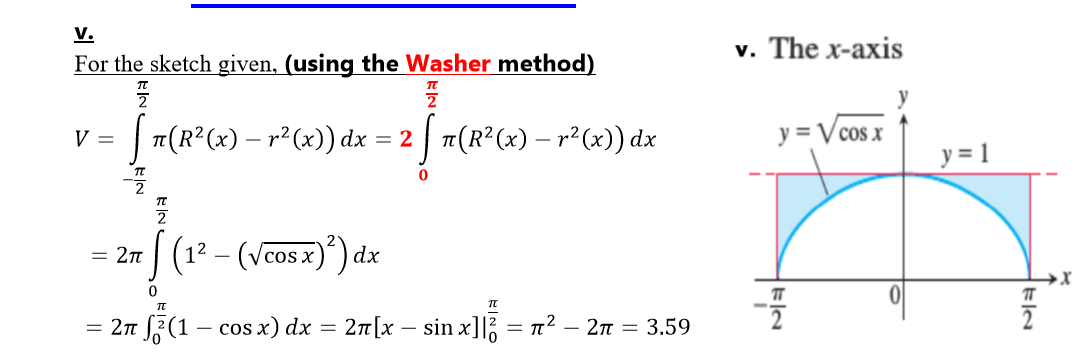
As The Axis Of Revolution Does Not Belong To The Region R We Can Use The Washer Method To Calculate The Volume.
This method is just an extension of the disk method to d etermine the volume of a hollow solid of revolution. It helps a user to integrate along axis parallel to the axis of revolution. It is also known as volume of solid of revolution calculator.
First, We Will Graph Our Bounded Region.
Now we have the r ² value. Solids of revolution (washer method) conic sections: To calculate the capacity, multiply the number calculated in step 4 by pi ( x 1.46 = 4.58).
Volume By Washers Added Apr 18, 2014 By Smgamm In Mathematics Calculate The Volume Of A Figure Bounded By Two Functions And Two Limits Using The Washers Meathod
The washer method is perfect for calculating the volume of this figure. Geometry tells you how to figure the volumes of simple solids. By making slight modifications to these methods, we can find volumes of solids of revolution resulting from revolving regions.
When Calculating The Volume Of Rotation, There Are 3 Factors That Determine How To Set Up The Integral.
Calculate the volume of the solid, ignoring the hole, find the volume of the hole and then subtract it. I can determine when solids generated by revolution will have hollow spaces. The area function can then be found from the radii, r1 and r2:


Comments
Post a Comment